.300 Blackout Explained:
Barrel Length, Suppressors, and Subsonic vs. Supersonic Ammunition
Miami International Arms | Firearms Education
The .300 AAC Blackout has an unusual reputation: it is a centerfire rifle cartridge that many people associate with remarkably subdued suppressed gunfire. But the cartridge's appeal is not explained by a single sound measurement. Its history, ammunition choices, barrel-length characteristics, and compatibility with compact AR-pattern firearms all contribute to the story.
Understanding those differences is useful whether you're comparing ammunition labels, interpreting suppressor test results, or learning why .300 Blackout has become a familiar name in discussions of modern rifle design.
Where .300 Blackout Came From
Advanced Armament Corporation and Remington developed .300 AAC Blackout, which was standardized by SAAMI in 2011. It is also known as .300 BLK or 7.62×35 mm. The design sought to accommodate .30-caliber ammunition in an AR-pattern platform, including both conventional supersonic and heavy subsonic loads. Suppressed use and compact firearm configurations were important parts of that development story.
The result was not a cartridge that magically makes every firearm silent. Rather, it was a cartridge family with two distinct velocity categories, each producing a different acoustic and ballistic profile.
What Actually Makes Suppressed .300 Blackout Quiet?
A gunshot has more than one sound source. Rapidly expanding propellant gases produce muzzle blast. A projectile traveling faster than the local speed of sound produces a ballistic shock wave. Semiautomatic firearms also make mechanical noise as the action cycles.
A suppressor primarily manages the expanding gases leaving the muzzle. It does not erase the shock wave from a supersonic projectile. Subsonic ammunition avoids that shock wave because the projectile travels below the speed of sound.
Those two effects explain why a suppressed firearm firing subsonic .300 Blackout can sound dramatically different from one firing supersonic ammunition. They do not mean the firearm is silent or automatically safe for unprotected hearing.
The local speed of sound varies with atmospheric conditions, so "subsonic" should be evaluated using actual ammunition performance rather than a universal fixed velocity.
Subsonic and Supersonic: Two Very Different Experiences
| Feature | Subsonic .300 Blackout | Supersonic .300 Blackout |
|---|---|---|
| Common projectile weights | Often about 190–220 grains | Often about 110–150 grains |
| Projectile speed | Below local speed of sound | Above local speed of sound |
| Ballistic shock wave | Absent | Present |
| Trajectory | Generally more curved | Generally flatter |
| Sound when suppressed | Can be notably subdued | Muzzle blast reduced, but ballistic crack remains |
| Projectile behavior | Depends on bullet construction and impact conditions | Depends on bullet construction and impact conditions |
These are broad categories, not universal product specifications. Bullet weights, velocities, and pressure characteristics vary among manufacturers and loads.
An important misconception is that a heavier subsonic bullet must behave like a faster supersonic bullet simply because both are .300 Blackout. Their flight characteristics and terminal behavior can be substantially different. Bullet construction matters at least as much as the cartridge label when interpreting product claims.
Barrel Length: Why It Matters
Barrel length changes the time and distance over which expanding gases accelerate a projectile. It also influences the gas pressure remaining when the bullet exits the muzzle.
That means two .300 Blackout firearms with different barrel lengths can produce different velocities, muzzle pressures, and sound signatures even with identical ammunition.
A few broad categories help explain the design landscape:
| Barrel Category | What Changes Technically |
|---|---|
| Around 7–8 inches | Compact overall dimensions; muzzle pressure and ammunition-dependent velocity deserve particular attention |
| Around 9–10.5 inches | Still compact; performance varies with ammunition, barrel design, and firearm |
| Around 16 inches | Longer overall firearm; may produce different velocity and muzzle-pressure results with the same ammunition |
This is not a ranking of recommended defensive barrel lengths. There is no universal point at which .300 Blackout suddenly becomes fully efficient, and no fixed barrel length guarantees the quietest result.
The familiar claim that ".300 Blackout burns all its powder in nine inches" is too simplistic. Propellant chemistry, ammunition loading, and barrel characteristics differ. A short barrel can be central to a cartridge's design history without making all other barrel lengths equivalent.
Readers comparing published velocity numbers should check whether the figures came from the same ammunition, barrel length, and test conditions.
What a Suppressor Changes—and What It Doesn't
Suppressors reduce aspects of the gunshot by altering how high-pressure combustion gases expand and leave the muzzle. Internal designs vary. Conventional baffle arrangements and low-backpressure designs can produce different acoustic signatures and different effects on semiautomatic firearm operation.
There is no manufacturer-neutral reason to declare one entire suppressor category the winner in every circumstance. Sound measured near the muzzle and sound measured near the shooter's ear can differ. The firearm's action, ammunition, and measurement methodology all influence the outcome.
Independent acoustic work, including PEW Science's published sound-signature research, helps illustrate why one advertised decibel number is an incomplete description of a suppressor.
Suppressor compatibility is also a safety issue. Manufacturers may specify cartridge ratings, barrel-length restrictions, firing schedules, and maintenance requirements. Those published limits should be followed rather than inferred from appearance or caliber alone.
Is .300 Blackout the Quietest Suppressed Cartridge?
Not necessarily. A suppressed subsonic .22 LR firearm can be quieter because the cartridge produces relatively little propellant gas. Subsonic 9mm and many standard-pressure .45 ACP loads can also yield very subdued sound signatures.
The relative ranking of 9mm, .45 ACP, and subsonic .300 Blackout is not universal. Different firearms and suppressors can change the results, especially when comparing muzzle measurements with sound near the operator.
What distinguishes .300 Blackout is its combination of centerfire rifle-platform compatibility and its distinct supersonic and subsonic ammunition categories—not an uncontested claim to being the quietest cartridge in existence.
Why the Cartridge Comes Up in Home-Defense Discussions
Compact firearm dimensions and reduced muzzle blast explain why .300 Blackout appears in discussions of firearms kept for lawful personal protection. But acoustic comfort should never be mistaken for a complete safety assessment.
Gunfire indoors can reflect from hard surfaces and still pose a hearing hazard, even with a suppressor. Heavy subsonic bullets can pass through drywall and other household materials. Their lower speed does not automatically make them less dangerous to people beyond a wall.
Reliability also varies among firearms and ammunition products. Not every semiautomatic firearm behaves identically with every subsonic and supersonic load. Owners should follow manufacturer compatibility and safety guidance.
Safe storage, awareness of other occupants, secure identification, emergency planning, and applicable law matter far more than a marketing claim that any cartridge is "ideal" for a confrontation.
Can the Same .300 Blackout Firearm Fire Subsonic and Supersonic Ammunition?
The cartridge is commercially available in both categories, and many firearms chambered for .300 Blackout are intended to accommodate both. However, owners should not assume that every firearm will function identically with every load or accessory. Manufacturer specifications and ammunition labeling remain essential.
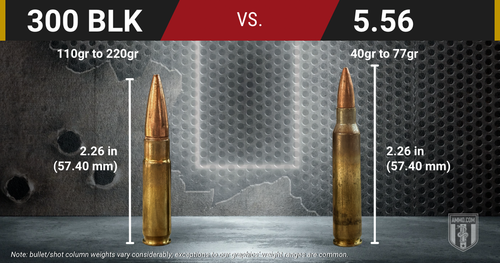
Another critical safety point: .300 Blackout ammunition can be confused with 5.56 NATO ammunition because both are associated with AR-pattern platforms. Mixing incompatible ammunition and firearms can cause catastrophic damage and injury. Always confirm the firearm's chamber marking and the exact ammunition designation before loading.
How to Interpret Suppressor Testing
When reading a suppressor review, ask what was actually measured. Was the ammunition subsonic? Which firearm and barrel were used? Was the sound captured at the muzzle, near the shooter's ear, or both? Were the tests conducted under comparable conditions?
A result measured on one host firearm should not be treated as a guaranteed result on another. Subjective impressions can be interesting, but standardized measurements and transparent test methods are much more useful for meaningful comparisons.
And remember: a quiet-sounding shot is not proof of safe exposure. Appropriate hearing protection remains important.
The Bottom Line
.300 Blackout earned its reputation because it brings together several unusual characteristics: compatibility with compact AR-pattern firearms, commercially available supersonic and subsonic ammunition, and the potential for notably reduced sound when subsonic ammunition is used with an effective suppressor.
Its limitations deserve equal attention. Barrel length changes pressure and velocity. Suppressor designs behave differently. Subsonic ammunition does not eliminate wall-penetration risks, and suppressed gunfire can still harm hearing.
The interesting story is not that .300 Blackout is a magical silent cartridge. It is that its design helped make suppressed centerfire rifle performance a mainstream topic of technical discussion.
Miami International Arms provides manufacturer-neutral education about firearms, ammunition, suppressors, and applicable ownership requirements. Contact our team for information about product specifications, compatibility documentation, and NFA services.
Frequently Asked Questions
Was .300 Blackout Designed for Suppressors?
Suppressed use and compact AR-pattern firearm compatibility were important considerations in its development.
Is Subsonic .300 Blackout Silent?
No. Subsonic ammunition eliminates the projectile's ballistic crack, but muzzle blast and mechanical noise remain.
Is a Shorter .300 Blackout Barrel Always Quieter?
No. Barrel length affects muzzle pressure and other conditions, but the full sound signature also depends on ammunition, suppressor design, and the firearm.
Does Supersonic .300 Blackout Benefit From a Suppressor?
A suppressor can reduce muzzle blast, but it does not eliminate the supersonic projectile's shock wave.
Is Suppressed .300 Blackout Hearing-Safe?
Not automatically. Hazardous impulse noise may remain, and hearing protection is recommended.
Is .300 Blackout Quieter Than Suppressed 9mm?
There is no universal ranking; comparisons depend on the tested firearm, ammunition, suppressor, and measurement location.
Can Subsonic .300 Blackout Penetrate Interior Walls?
Yes. Subsonic velocity does not prevent penetration of household materials.
Can a .300 Blackout Firearm Use Both Ammunition Categories?
Many are intended to, but compatibility and reliable function must be verified against manufacturer specifications.
References and Further Reading
- SAAMI — Cartridge standards and industry technical resources.
- PEW Science: Silencer Sound Standard — Suppressor acoustic evaluation framework.
- PEW Science: Public Sound Signature Reviews — Examples of documented independent suppressor testing.
- NIOSH — Hearing and occupational exposure resources.
- ATF Firearms — Federal regulatory information.
Editorial independence: Miami International Arms has not received compensation from any firearm manufacturer for this article.
This article is educational, not legal advice or an endorsement of a specific firearm for defensive use.