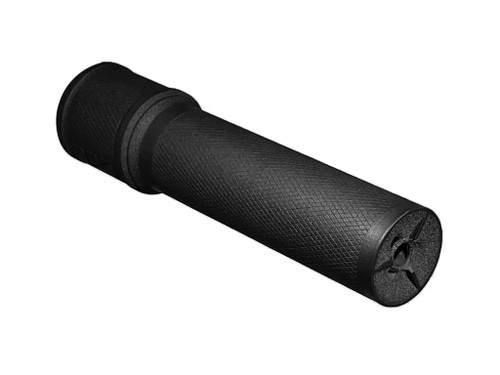
Suppressor Materials Explained: Stainless Steel, Titanium, and Inconel
If you’re comparing suppressors, you’ll see terms like Grade 5 titanium, 17-4 stainless steel, Inconel 718, and 3D-printed metal. The first three describe the alloy. The last describes how the part was made. Both matter when you’re reading a product specification, but they answer different questions.
At Miami International Arms, we hear two questions often enough to cover them together: What are the advantages and disadvantages of each suppressor material, and how does metal 3D printing compare with CNC machining?
Stainless steel vs. titanium vs. Inconel
|
Material |
Main advantage |
Main trade-off |
Can it be metal 3D printed? |
|---|---|---|---|
|
Stainless steel |
Good combination of strength, corrosion resistance, and cost |
Heavier than titanium at equal volume |
Yes. Examples include 17-4 PH and 316L. |
|
Grade 5 titanium |
High strength for its weight and excellent corrosion resistance |
Generally costs more than stainless steel and retains less strength at elevated temperatures than Inconel 718 |
Yes. Grade 5 is also called Ti-6Al-4V. |
|
Inconel |
Grades such as 718 retain strength at elevated temperatures |
Dense, generally expensive, and difficult to machine |
Yes. Examples include nickel alloys 625 and 718. |
Commercial industrial metal printing systems support grades from all three material families.
Stainless steel is the all-around option
Stainless steel offers a practical balance of strength, corrosion resistance, and material cost. The grade matters. 17-4 PH stainless steel, for example, can be hardened through heat treatment to achieve high strength. 316L stainless steel is a different grade known for its corrosion resistance.
The biggest trade-off is weight. For the same volume of material, stainless steel weighs substantially more than Grade 5 titanium. When comparing finished products, check the listed weight for the specific model. Part size and geometry also affect what ends up on the scale.
Titanium stands out for low weight
Grade 5 titanium, also known as Ti-6Al-4V, combines high strength for its weight with excellent corrosion resistance. It has a density of about 4.43 grams per cubic centimeter, roughly 40 to 45 percent lower than typical stainless steel. That comparison assumes equal volumes of material.
Titanium generally costs more than stainless steel. It also gives up some elevated-temperature strength compared with Inconel 718. Those are two separate trade-offs to keep in mind when a product description highlights titanium.
Inconel stands out for high-temperature strength
Inconel is a family of nickel-based alloys. Inconel 718 is known for retaining strength at elevated temperatures. It’s also slightly denser than typical stainless steel and considerably denser than Grade 5 titanium. Material cost and machining difficulty are additional trade-offs.
A product description may list Inconel 625 or Inconel 718. The number matters because each is a distinct alloy with its own properties.
Metal 3D printing vs. CNC machining
Metal 3D printing, also called additive manufacturing, builds a part layer by layer. Its biggest advantage is the freedom to produce complex shapes, including internal features that conventional cutting tools may struggle to reach. It can also let a manufacturer combine several pieces into a single part.
The trade-off is that an as-printed part typically has a rougher surface finish and may need additional work to meet dimensional requirements. Depending on the part, that can include heat treatment, surface finishing, inspection, or machining.
CNC machining starts with solid stock and removes material with cutting tools. It’s particularly good at producing smooth surfaces and tight dimensional tolerances on accessible features. It can also be more economical for simple shapes.
A single finished part can involve both processes. A manufacturer can print the overall shape, then machine the surfaces that need a precise fit. That’s why 3D printed and CNC machined can both appear in the same product description.
Frequently asked questions
Can stainless steel, titanium, and Inconel all be 3D printed?
Yes. Industrial metal additive manufacturing supports specific grades of all three, including 17-4 PH and 316L stainless steel, Grade 5 titanium, and nickel alloys 625 and 718.
Is titanium lighter than stainless steel and Inconel?
Yes. Grade 5 titanium is considerably less dense than typical stainless steel and Inconel 718. The actual weight difference between finished products depends on their size and geometry.
Is a 3D-printed metal part stronger than a machined part?
The manufacturing label alone can’t tell you. Strength depends on the alloy, how it was processed and heat treated, and the finished part’s geometry. For a meaningful comparison, look for test data that applies to the specific product.
Does the suppressor material tell you how quiet it is?
The alloy name alone can’t predict sound levels. Compare published sound measurements taken under similar conditions, including where the microphone was placed. A reading near the muzzle answers a different question from a reading near the shooter’s ear.
Have a question about a material or manufacturing term you saw on a spec sheet? Miami International Arms can help you understand what the manufacturer’s specifications mean.